


I’m 19 years old. Working at a theme park in the middle of summer. Hosting a live, special effects show for tourists who had been walking around in the sun for six hours and just wanted an excuse to get some air conditioning.
For about 20 minutes at a time, I pretended to be a Hollywood professional explaining how movie magic worked. And I took this job very seriously.
Probably too seriously.
As part of the show, I had to select some volunteers from the audience to help participate in shooting a special effects scene. Our instructions as employees were to just pick people as quickly as possible (we’ve got a show to do, after all, and an hour-long line outside). But like I said, I took all of this very seriously.
I was young. Maybe with a bit of an ego. And part of it was that I grew up going to theme parks myself, watching shows exactly like this, desperately hoping I’d be the person who got picked as a volunteer. So now here I am, on the other side - the one choosing people - and I wanted to make that moment count.
During one particular show, I swiftly picked 3 enthusiastic looking volunteers who would be harnessed into a giant submarine set piece, holding onto hidden safety rails inside while everything rocked back and forth simulating a float on the surface of the water.1
My show stagehand talked them through the setup. Smiles all around. Everyone seemed excited and ready to go.
When it was time to shoot the scene, I gave them direction.
“When I say action, point out toward the audience — like you see something at sea, way off in the distance.”
Action!
Two of them nailed it. The best pointing you’ve ever seen.
The third… didn’t.
But hey, it happens. We had tourists from all over the world coming through the park. I figured maybe he couldn’t hear me. Maybe English wasn’t his first language. Maybe he was overwhelmed. He was smiling. He seemed present. He just wasn’t doing the thing.
And instead of slowing down, or checking in, or adjusting the direction, I did what 19-year-old me thought you were supposed to do as a “director":
I pushed.
I actually… screamed.
I tried to control the moment.
“You, guy on the end — point toward the audience!”
He was gripping the safety rail with his left hand.
And then he lifted his right arm.
Or tried to.
That’s when I saw it.
He didn’t have an arm. He physically couldn’t.
I was yelling at a one-armed man to point.
The audience realized it instantly. Like out of an actual movie, there was an audible gasp from the crowd. The whole thing probably lasted two or three seconds, but it felt like an eternity.
“And, cut!” I yelled quickly. Finished the scene. Wrapped the show. Did what you do when something goes wrong in front of an audience of 200 people: pretend it didn’t.
But I knew I had made a huge mistake. I felt terrible.
After the show, I found the guy and apologized. And he was super gracious - much kinder than he needed to be. He told me I was just going my job… apparently playing an asshole film director.
The audience filed out of the soundstage, and I made my way back out front to start another show. From that point on, I didn’t necessarily discriminate and only pick volunteers with two arms - but I definitely paid a little more attention to what was going on, instead of operating on auto-pilot.
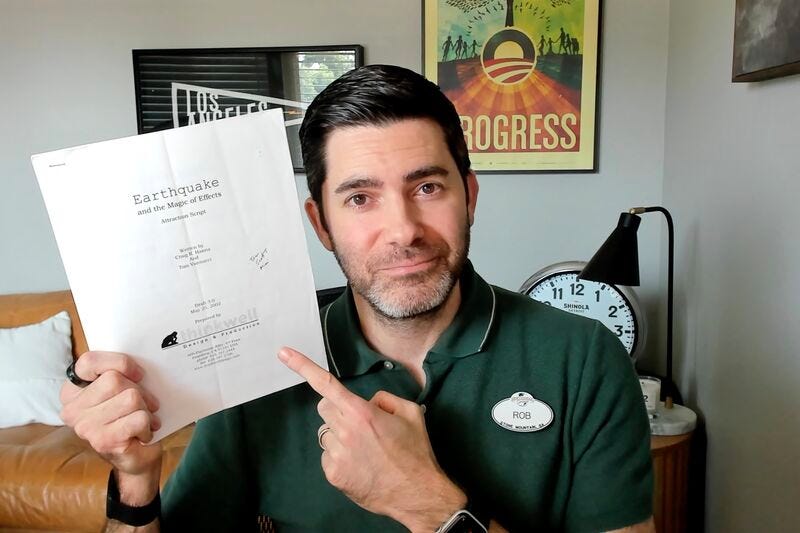
I’ve thought about that moment a lot over the years. Clearly, given how much detail I still remember.
I wasn’t trying to be cruel or embarrass anyone. I was just doing what I thought you were supposed to do: keep things moving, give clear direction, don’t lose momentum.
Back then, I believed that if you just directed harder, you could fix almost anything. What I didn’t understand yet was that sometimes direction isn’t the problem—speed is.
That day, I wasn’t paying attention to the person standing in front of me. I was paying attention to the show. To the timing. To the next beat. And in the process, I missed something pretty damn obvious.
That moment stuck with me longer than I expected.
Not because it was dramatic (though it was), but because it showed me how easy it is to miss what’s right in front of you when you’re moving too fast.
Since then, I push less when something isn’t landing. I pause more. I try to notice when momentum is actually helping, vs. when it’s just making me careless.
Every experience has a point where direction stops being useful… and attention matters more.
It took me a while to learn where that line is.
I’m still learning it, honestly.
—
This felt like the right story to start with - it’s one of my favorites for good reason. In my next issue, I’ll tell you about the time I made a famous actress cry. 🥺
Thanks for reading, and for being here this early.
— Rob